

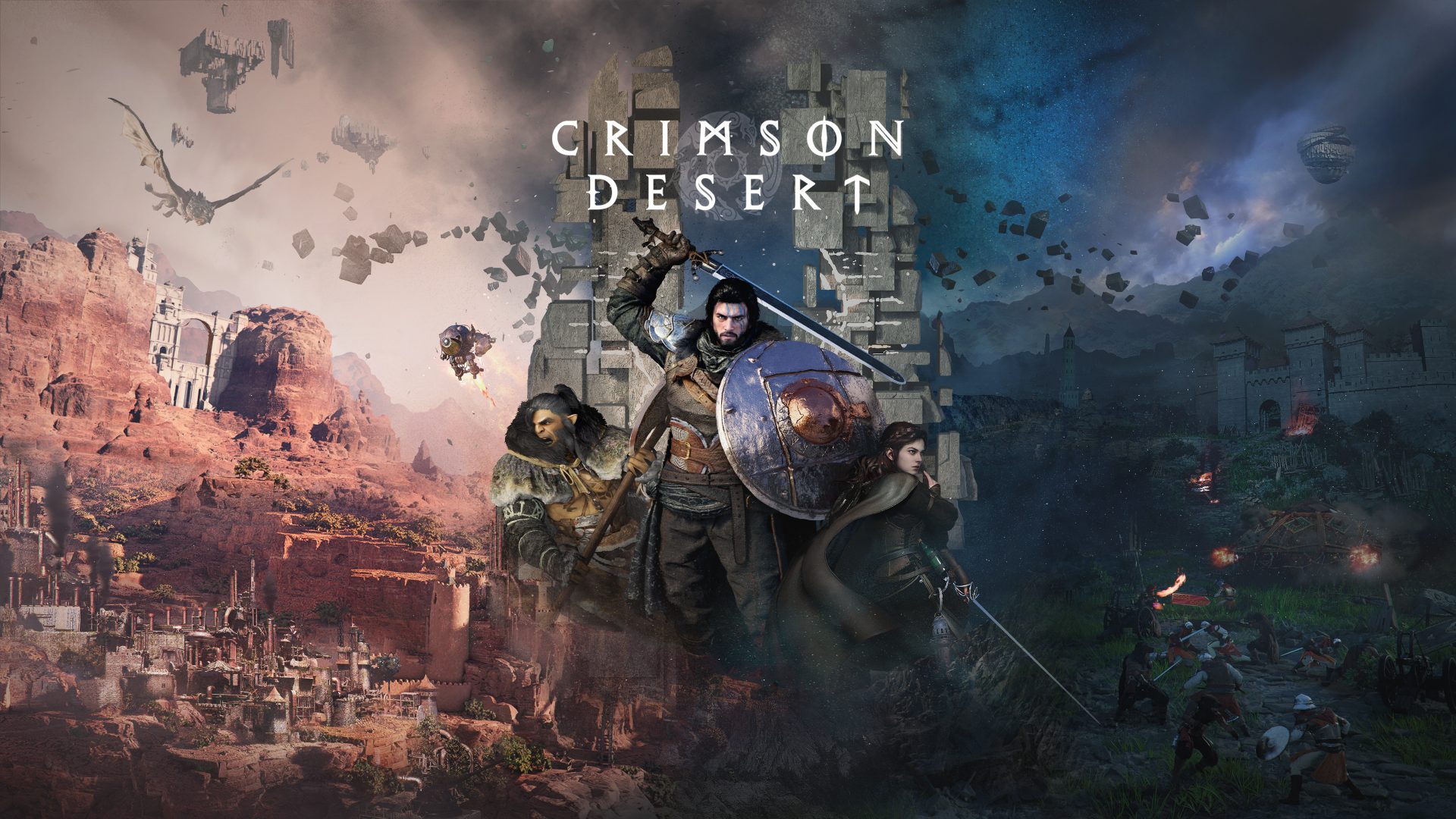
Crimson Desert
March 19, 2026
Platform
PC (Steam, Epic Games Store, Microsoft Store), PlayStation 5, Xbox Series X|S
Publisher
Pearl Abyss
Developer
Pearl Abyss
Open-world games are among the most popular video game genres nowadays, but it’s undeniable that, among the many released each year, only a few achieve widespread success and enduring popularity. This isn’t very surprising. While the idea of having huge maps filled with activities and secrets to discover is always enticing, the execution makes all the difference. Those that fall into the “Ubisoft” open-world formula often become tiring very quickly without a strong, cohesive narrative, while those that do away with markers and quest indicators, leaving players on their own, like Zelda: Breath of the Wild, Tears of the Kingdom, and Elden Ring, fare considerably better.
With only a few developers mastering the art of open-world games, the skepticism surrounding Crimson Desert, Pearl Abyss’s first foray into single-player games following the MMO Black Desert, was expected. While the game looked stunning almost right from its reveal, the many unknowns on its gameplay formula, narrative, and world design made players justifiably wary.
However, as marketing ramped up ahead of the game’s release following a few delays, it started becoming clear how Crimson Desert could be an open-world game like few others packing an intense and involving combat system featuring multiple playable characters, intricate puzzles, and a massive game world powered by a metric ton of different mechanics ranging from a base system to riding mechs created with ancient, lost technology in a purely fantasy setting.
On paper, this sounded too good to be true. How could Pearl Abyss cram so much into their game when other, more experienced studios cannot? What’s the catch? I asked this question myself quite a few times as I learned more about Crimson Desert. While the hardcore, almost fighting games-inspired combat system immediately made my ears prickle, I wasn’t sure about everything else.
After spending roughly 30 hours with Crimson Desert, I am not yet ready for a final verdict. The reason is simple: of these 30 hours, less than half were spent on the main story, and all of them within the very first area of the game. Pywell is a world that is very easy to get lost in. And for all the best reasons.
The Plight of the Greymanes
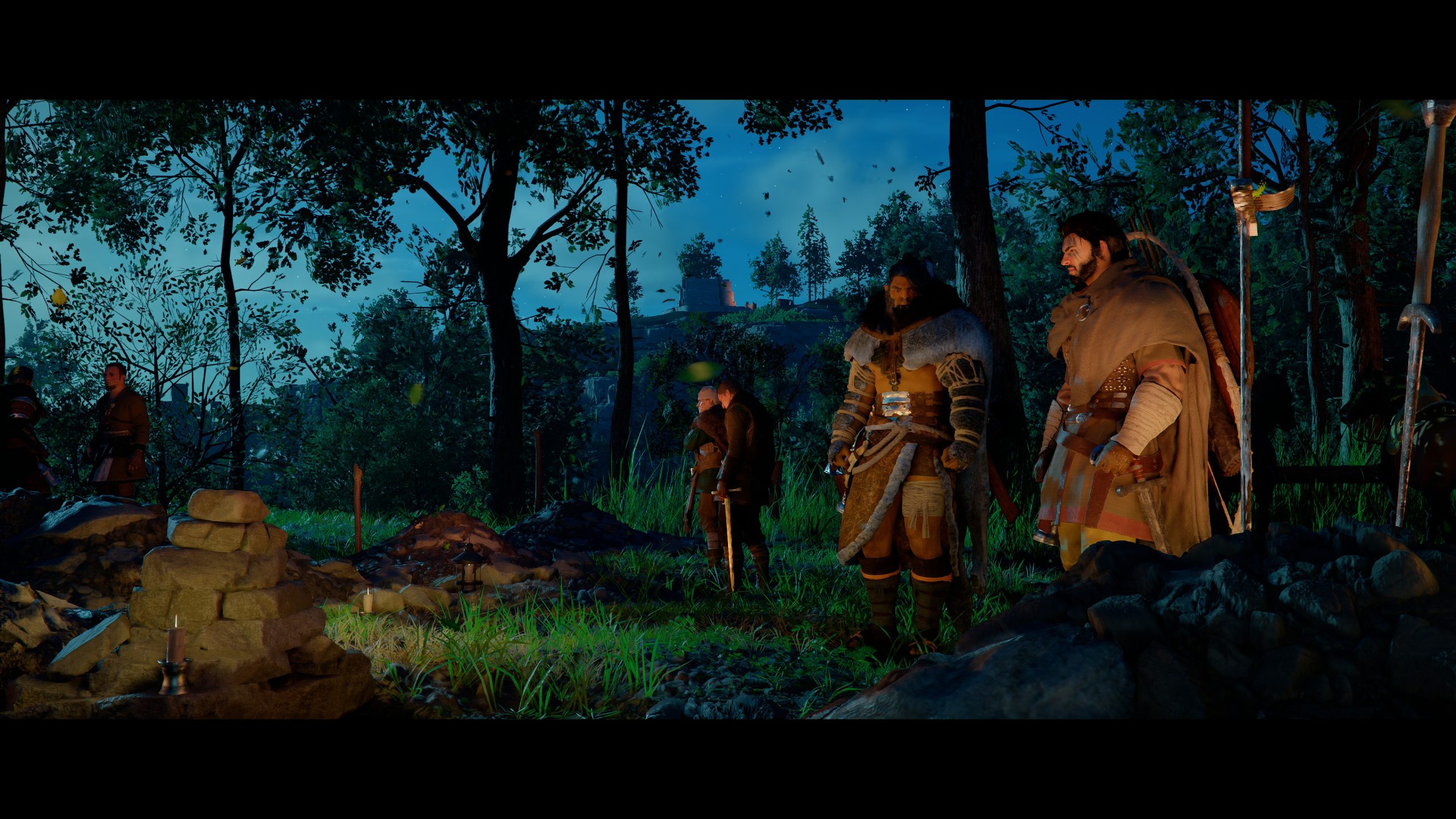
Crimson Desert is set on the continent of Pywel, a brutal medieval fantasy land in a state of chaos. The King of Demeniss, known as the Unifier of Lands, has fallen into a coma, leaving a huge power vacuum that rival factions are attempting to fill. One victim of this state of complete chaos is Kliff Macduff, a grizzled warrior, and his renowned band of mercenaries, the Greymanes. During a night ambush, the Greymanes are attacked by the Black Bears led by Myurdin, their sworn enemies, and they are decimated, with only a few able to escape the assault. After an intense confrontation with Myurdin himself, Kliff is critically wounded and left for dead.
However, Kliff survived his grievous wounds. After a short venture into the mysterious Abyss, where ancient technology powers all sorts of contraptions, the mercenary has his wounds tended by a kind individual, and after a few days of rest, he ventures out in the region of Hernand to find his lost companions and eventually exact revenge on those who did them wrong.
While the revenge story remains one of the central motivations for Kliff for a good portion of the story, Crimson Desert is much more than that. Shortly after the prologue ends, Kliff is transported to the Abyss again, where he not only gains powers that will prove critical during his journey but also learns about the imbalance gripping the world and his role as its savior. This sort of “chosen one” storyline is often intertwined with the worldly affairs of the restored Greymanes, giving the entire plot a bit more substance and layering.
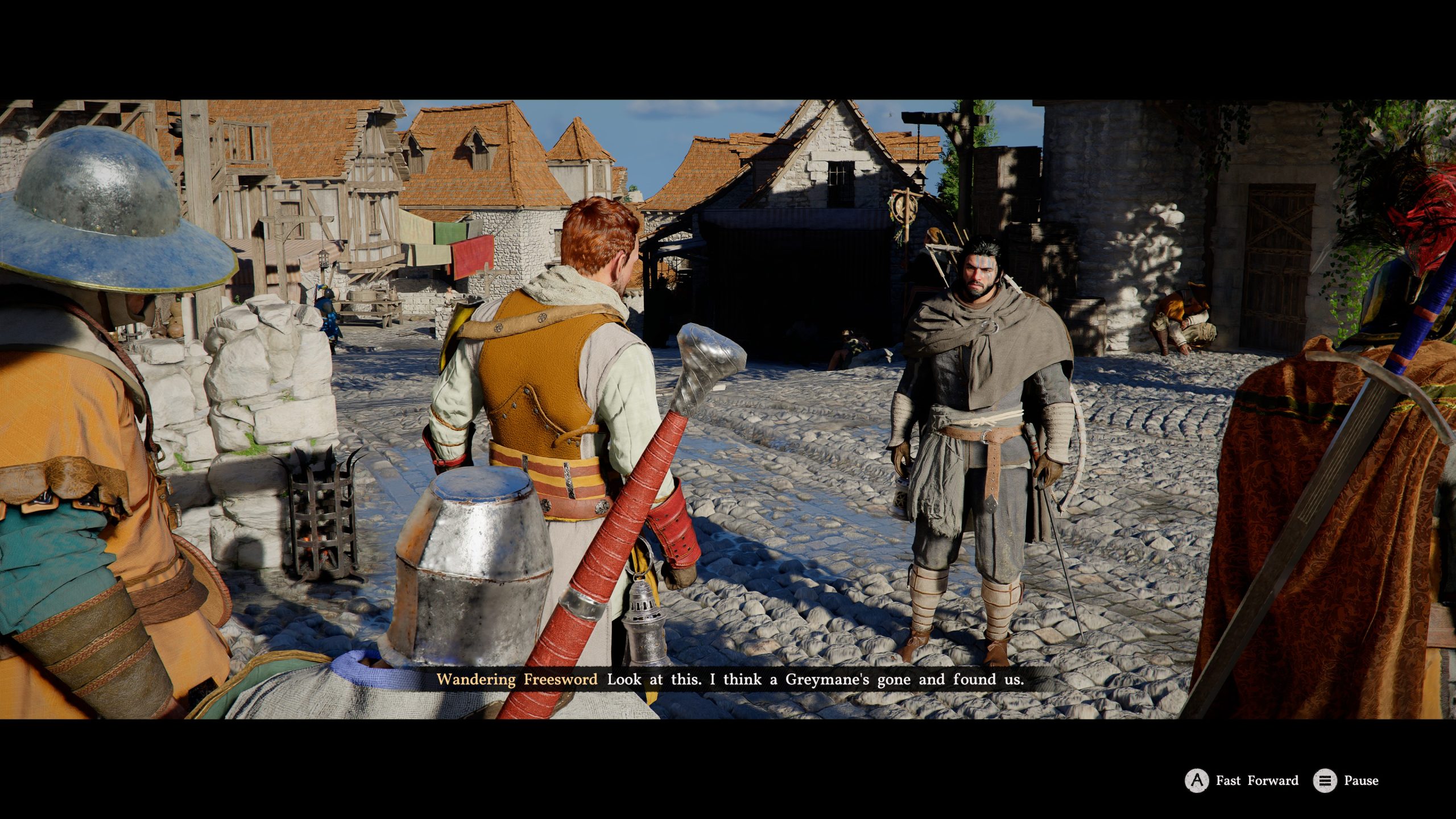
Since I haven’t completed the story yet, I cannot say if the narrative eventually delivers. What I can say, however, is that so far it’s only serviceable, and this doesn’t have anything to do with its themes, however predictable they could be, but in how it’s presented. When Kliff learns of how he is supposed to essentially save the world, he doesn’t react at all! Nor is he asking the alchemist who revealed to him his chosen status what the Abyss is, where his powers come from, and why he was chosen. He just takes everything in stride, believes the White Crow woman who granted him the power of flight, and jumps headfirst into the void to return to Pywell, not really questioning if he will end up a smear of blood on the ground from a hundred – if not thousands – of meters fall.
Unfortunately, this disconnect persists throughout the experience. The first few story chapters, which act as tutorials of sorts, are filled with similar situations. Kliff goes from arm wrestling to chasing cats on rooftops without asking questions or providing a logical, coherent connection between the two. Mind you, in gameplay terms, completing these tasks is fun and adds great variety to the experience, but a better setup would have made the onboarding more enjoyable. As things are, it feels like you are jumping between them just because Kliff has nothing better to do. Add in some forgettable characters, and the narrative’s first impressions aren’t particularly positive. In many ways, the first few hours reminded me of the Dragon’s Dogma series: a skeletal story with generally forgettable characters that barely justifies the gameplay.
A few chapters in, thankfully, things pick up, and the narrative starts becoming a tad more cohesive, although it still fails to delve deeper into its most interesting elements. However, by this point, Crimson Desert is in full swing, and its gameplay is more than enough to carry the entire experience.
Pywell is Your World To Play In
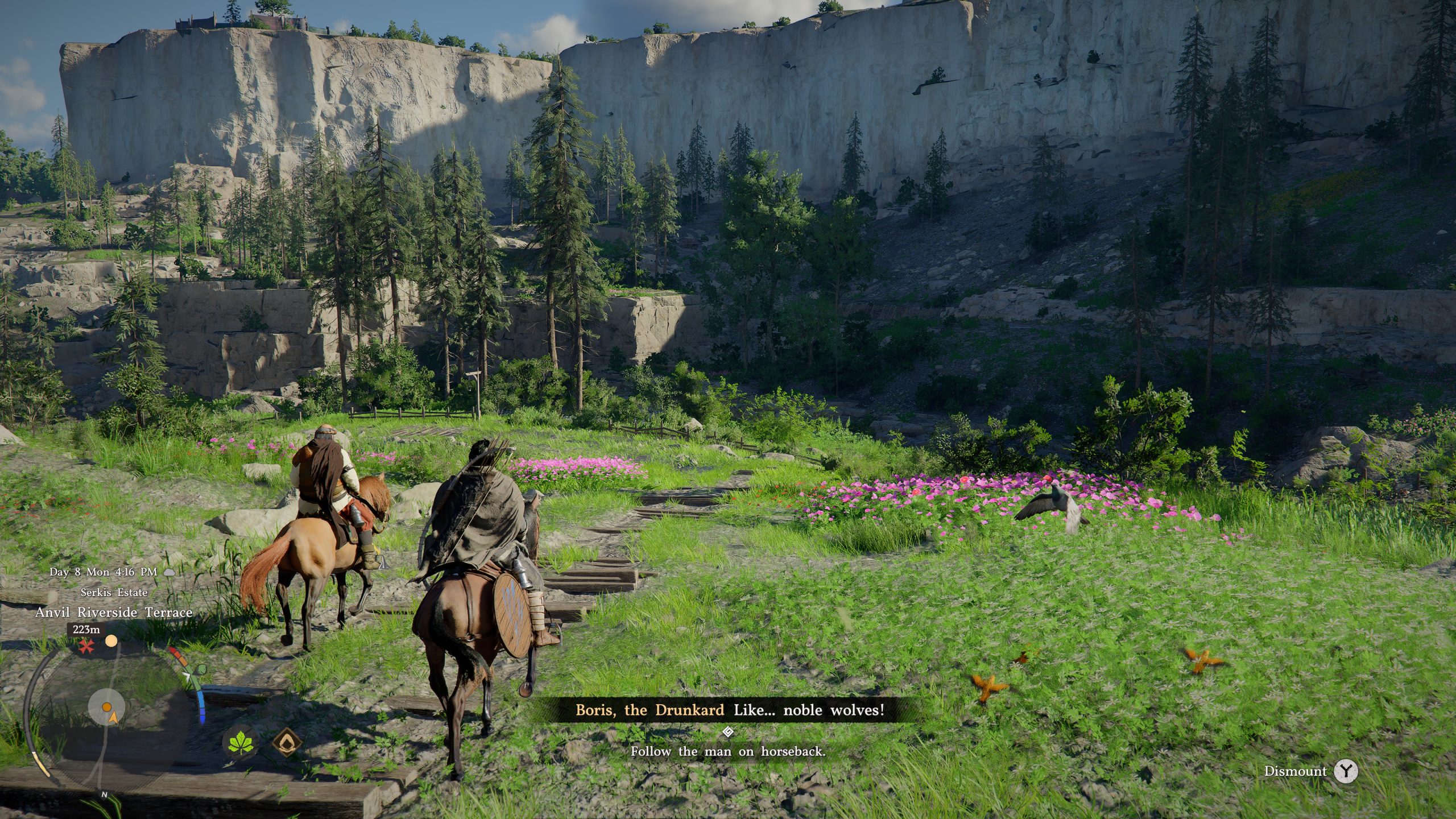
At its heart, Crimson Desert is an open-world game like many others. Controlling Kliff as well as others, such as the nimble gunslinger-swordswoman Damiane and the heavy hitter orc Oongka, players explore a huge map filled with all sorts of activities, ranging from the most mundane tasks of collecting resources to puzzle-solving and combat-focused activities. Striking a middle ground between the marker-filled map of Ubisoft’s trademark open-world formula and the no-handholding approach of Zelda: Breath of the Wild and Elden Ring, exploring Pywell is extremely engaging, also thanks to the game’s stunning visuals, which we will discuss in depth later.
One element that sets Pywell apart from the worlds seen in other similar games is its interactivity, as pretty much every element in it can be interacted with. The many NPCs that roam the world not only have their own schedule; they also populate the world in droves, making it feel very lively at all times. Whether in castles and towns or on roads, you can be sure to meet all sorts of individuals you can greet and befriend, or antagonize, if you’re itching for a fight. Similarly, animals like dogs and cats can be interacted with, and building bonds with them also brings some gameplay benefits. Befriended cats, for example, can loot items from defeated enemies.
In addition, you can interact with almost anything in the game’s world. Whether it’s stealing items, throwing NPCs around for fun, or engaging in pointless acts of vandalism, Crimson Desert has got you covered. You may have to answer for your crimes eventually, but if you believe the restoration of the Greymanes requires an unorthodox approach, you can go for it (although it does feel a bit disconnected from the narration of the Greymanes, generally seen as honorable warriors).
This high level of interactivity permeates every aspect of Crimson Desert‘s dense world, leading to creative problem-solving. For example, an early secondary quest required Kliff to release someone from a cart. While I could have used an ability to lift the cart, I ended up destroying it with a powerful kick. Not the most elegant of solutions, but it worked out in the end. The game is chock-full of these situations, which make the gameplay very dynamic, and I wouldn’t be surprised to see some more creative ways to tackle quest objectives down the line. To make another example, this world interactivity can also influence combat considerably: if a tree were to fall during a combat encounter, you could lift it up and smash it on the enemies to deal some serious damage. Or, if you’re fighting on a hill or mountain, you can use Palm Strike to push enemies below to either defeat them or put them out of the fight temporarily.
Similarly, there’s an early story quest that requires Kliff to dress properly to enter Hernand’s castle. However, if you have leveled up Stamina enough, you can simply climb the walls to gain access. Or, if you have improved Kliff’s Palm Strike ability, you can use it to propel into the air and then climb a smaller portion of the castle’s walls to gain access.
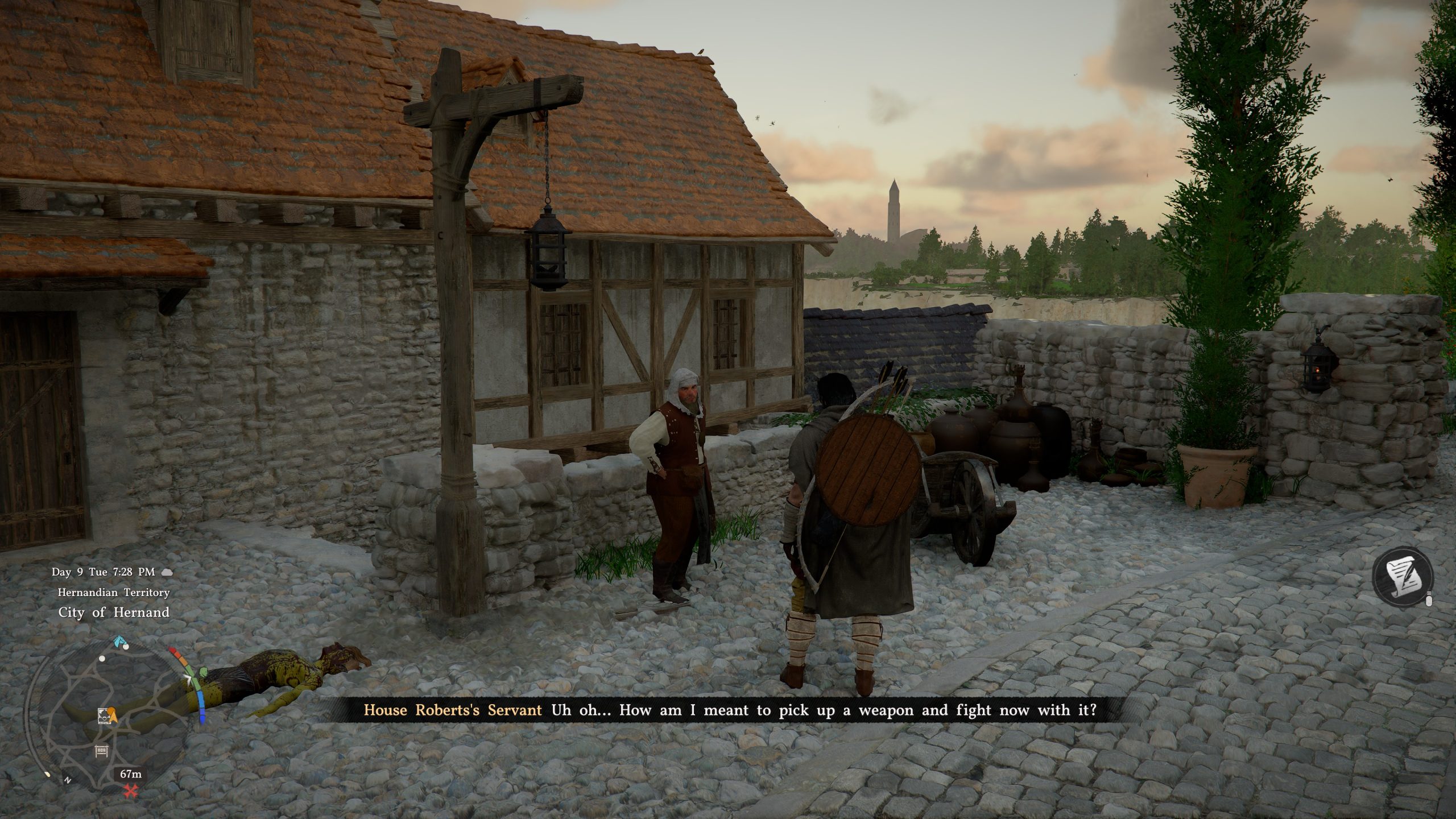
Even puzzle solving is governed by similar variables. Clearly inspired by Zelda: Breath of the Wild, Kliff often has to manipulate environmental elements to solve them, often with the Axiom Force ability, which lets him grab not only these elements but also parts of the environment itself and even enemies. And if you’re someone who doesn’t like the excessive handholding of modern games and yellow paint, you will be happy to know that Crimson Desert almost has none of it. If you can’t figure things out by yourself, the game is not going to help you. Needless to say, this is very refreshing and will please hardcore gamers a lot. None of the puzzles I encountered were terribly difficult, although some weren’t very easy to grasp on the fly, so this could be a pain point for some.
Crimson Desert‘s excellent interactivity is enhanced by the excellent design of its open-world, offering a staggering variety of locations with incredible verticality of which you can take advantage of in a lot of creative ways, thanks to the ability to climb pretty much anything à la Breath of the Wild, one of the Palm Strike secondary abilities which can propel Kliff in the air without expending stamina, and the ability to fly, or rather glide, once high in the air. With a massive selection of rides for a single-player open-world game, the game tackles the challenge of making traversal fun in a very competent way.
Without an interesting world to explore, any fun traversal mechanic may have been for nothing, but this is not Crimson Desert‘s case. The opposite is true, actually, as Pywel is among the densest fantasy open-world games ever. There isn’t a single time when the map feels barren or empty: NPCs are consistently met on the road, there’s animals in the forests and insects in the grass (all interactable with), and there’s always a camp or cave or dungeon that hides something nearby, or someone who has to offer you a quest of sorts, or is just waiting to play some game with Kliff such as arm wrestling and rock, paper, scissors.
And if, for some reason, you cannot find anything interesting in your vicinity, you can whip out your weapon and use the Blinding Flash ability to discover if there’s anything related to the Abyss nearby, including Artifacts used to unlock nodes in the skill trees, or an Abyss Nexus, which acts as a fast travel point. These are surprisingly quite sparse, but it’s not surprising to see this implementation of fast travel: with the world so densely packed with activities and things to do, reasons to fast travel are rather few.
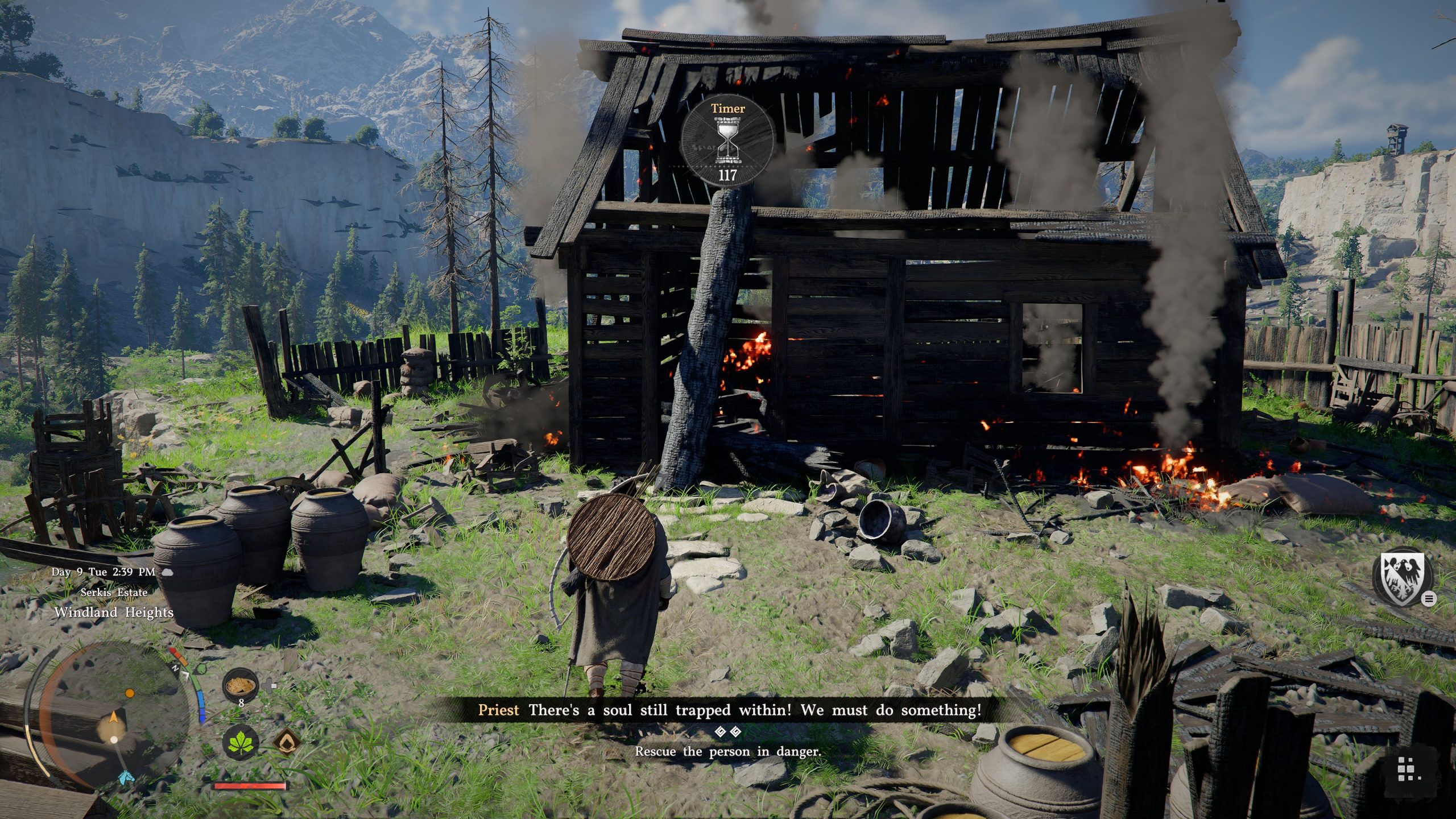
Crimson Desert‘s excellent open-world design is compounded by a similarly solid quest design. Generally taking good advantage of the sandbox mechanics of the world, these quests offer an incredible variety of situations, ranging from regular fetch quests and combat scenarios to tracking, light investigation, maneuvering contraptions, and climbing giant magical beings à la Shadow of the Colossus. Greymane’s camp management and customization also provide a significant amount of depth, with plenty of mechanics that are pretty similar to what one may expect to see in an MMO.
The only issue with such a diverse set of activities and quest objectives is the disconnect we have discussed above. While there’s some story behind many of the quests, it ranges from uninteresting to inoffensive, with a few exceptions that attempt to provide a deeper look at the world’s lore. It’s a shame the narrative elements weren’t a bigger focus, because the more you get involved in the game’s mechanics, the more this disconnect is evident: there’s no cohesive thread for all the gameplay mechanics, no reason for Kliff and the others to be able to do what he does beyond a simple “they just can, it’s the power of the Abyss.” Pearl Abyss set expectations right by saying this is no RPG à la The Witcher 3, but even a slightly more cohesive approach would have done wonders for the whole experience. A minor gripe on how fun the game is, but one I expect many will have with the game.
In a Fight, Anything Goes
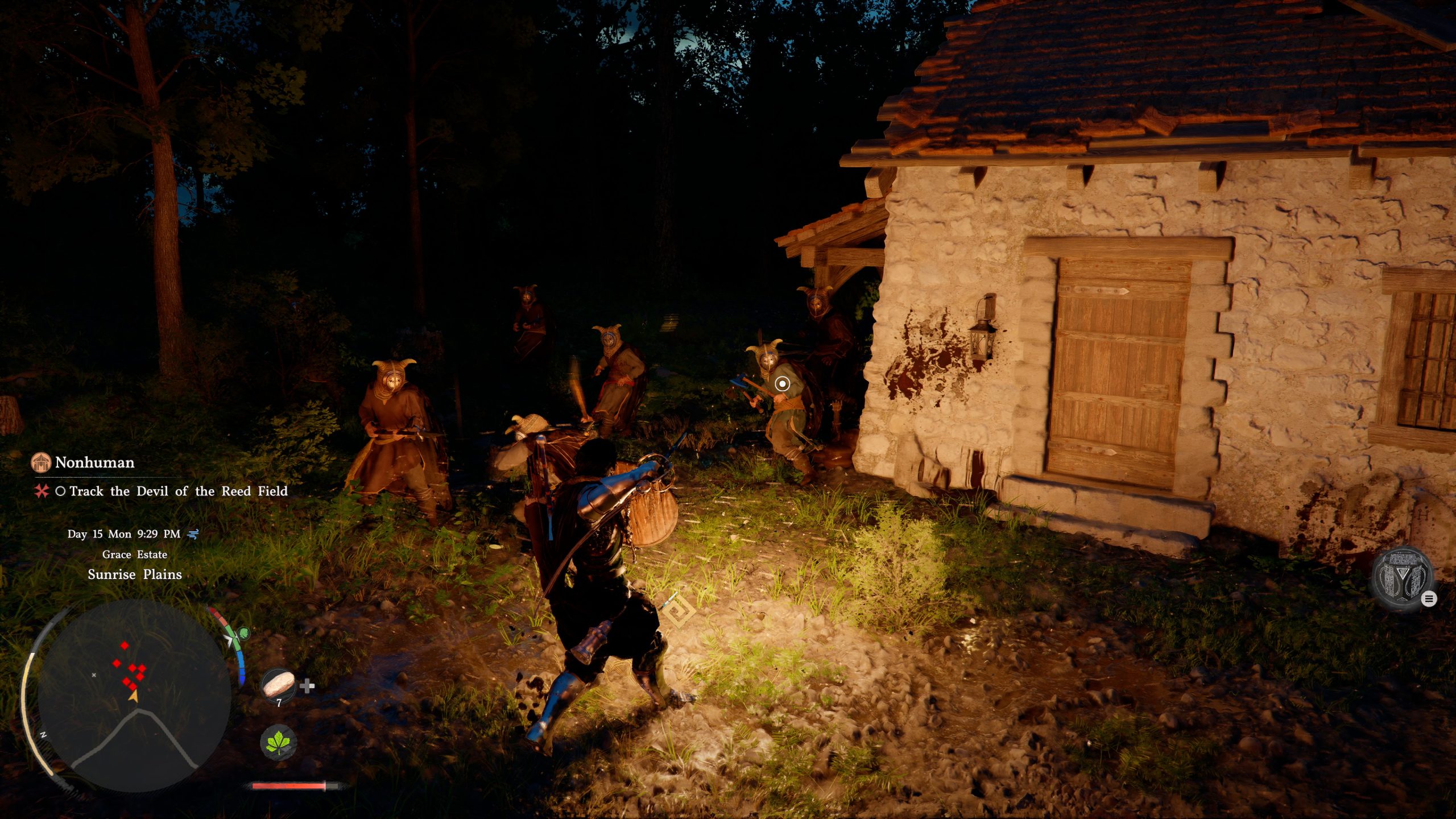
Besides setting expectations right by reiterating that Crimson Desert is not an RPG, Pearl Abyss stressed that it is an action open-world game, and in terms of action, the game fully delivers, applying the sandbox mechanics of its world to combat. This delivers one of the best combat systems seen in traditional open-world games to date, second only to Team NINJA’s Rise of the Ronin in my opinion.
At its heart, Crimson Desert‘s combat system feels not too different from those seen in third-person open-world RPGs like The Witcher 3, with some quirks, including character progression tied to gear and using Abyss Artifacts to unlock new skills and Health, Stamina, and Spirit improvements.
As most fights are against larger groups of enemies, the traditional lock-on system has been changed slightly to accommodate the need to free-flow between different targets, although a traditional lock-on is still possible by using the soft lock via the L1/LB button and then pressing down on the d-pad. Enemies are generally very aggressive and tend to attack together with support from ranged fighters, so learning to jump from one target to another is the key to success.
Where Crimson Desert deviates almost completely from every other game is the fighting game-like approach for the moveset. The basic light and heavier attack strings are barely the tip of the proverbial iceberg: all playable characters also have additional skills (some learned by watching enemies use them) such as movement-based attacks, grapples, elemental infusions, unarmed combat skills, aerial attacks, ranged abilities, counters and much more.
The best thing about all these attacks is that they can be chained together almost seamlessly. In some cases, chaining attacks is the way to go, as it reduces charging time considerably or simply works better due to positioning. The seamless chaining of skills also works for grapples, which are incredibly useful for crowd control and fun to see in action. Add elemental spells with very varied effects, parries, and perfect dodges to the mix, and taking advantage of the environment, such as using water for better electricity conductivity, and you get an incredibly involving combat system.
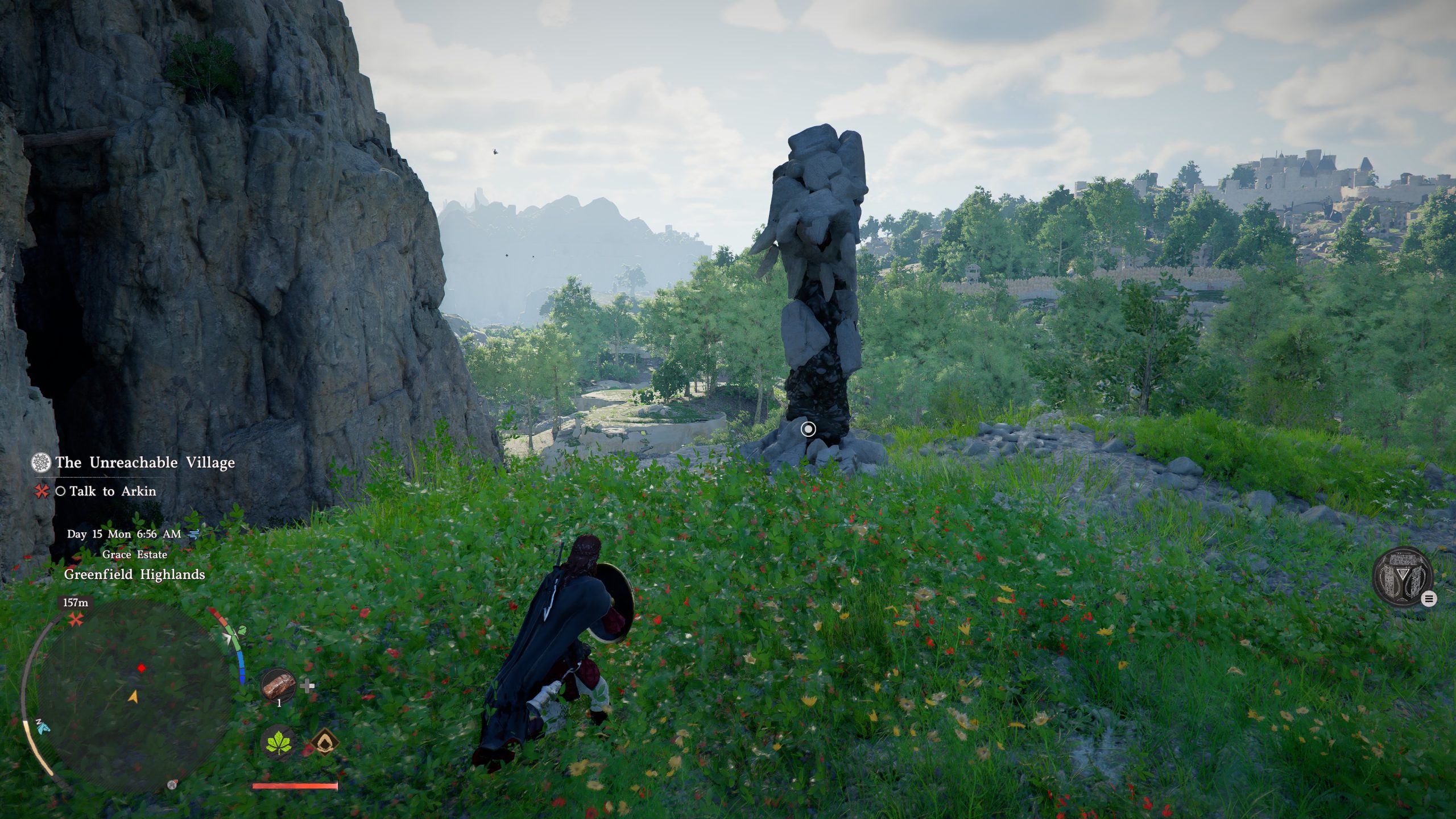
While a system like this allows for immense player expression, as pretty much every fighting style possible is more than viable without having to specifically build your character in a certain way, it comes with a level of complexity that could put off more than a few players. Sure, there’s no execution barrier like in a proper fighting game since there are no quarter circles or 360 motions, and the button combinations required to execute all of the learned skills can get a little overwhelming. It’s the price to pay for not having to choose between different skills, and one I am more than welcome to pay, but for someone who’s not used to fighting games, this can, and will, feel overwhelming.
No matter how overwhelming this can feel, however, I suggest pushing past the initial struggles. Both the narrative and the combat in the first five hours of the experience feel far from gripping, but past the slow first few chapters, Crimson Desert becomes extremely rewarding. Combat, in particular, massively expands with any new skill learned, opening up new ways to deal with enemies that can be extremely fun, especially in mass combat and cinematic combat situations, where some crowd control skills make the playable characters feel almost like super-heroes.
Enemy design also plays a big role in making the combat system feel very unique. While mobs are varied enough, ranging from your typical medieval fighters, bandits and everything in between to some more creative and unexpected enemies, bosses take the cake here. There are over 70 bosses in the game, and while I haven’t fought all of them, the ones I did take on were extremely diverse. Strong knights, a nobleman renegade with magical powers and a katana almost reminiscent of Vergil from Devil May Cry, mythical creatures, automatons: Crimson Desert truly has it all.
And, as opposed to a typical soulslike where openings are limited, here, if you play your cards right and take advantage of the environment, you can stun lock bosses easily, even without filling their stun gauge placed right below their health bar in the interface. This may constitute a balance issue, but you really need to go out of your way to accomplish this, so it’s not a major problem, only a consequence of the sandbox mechanics that permeate the entire experience.
Diamond In the Rough
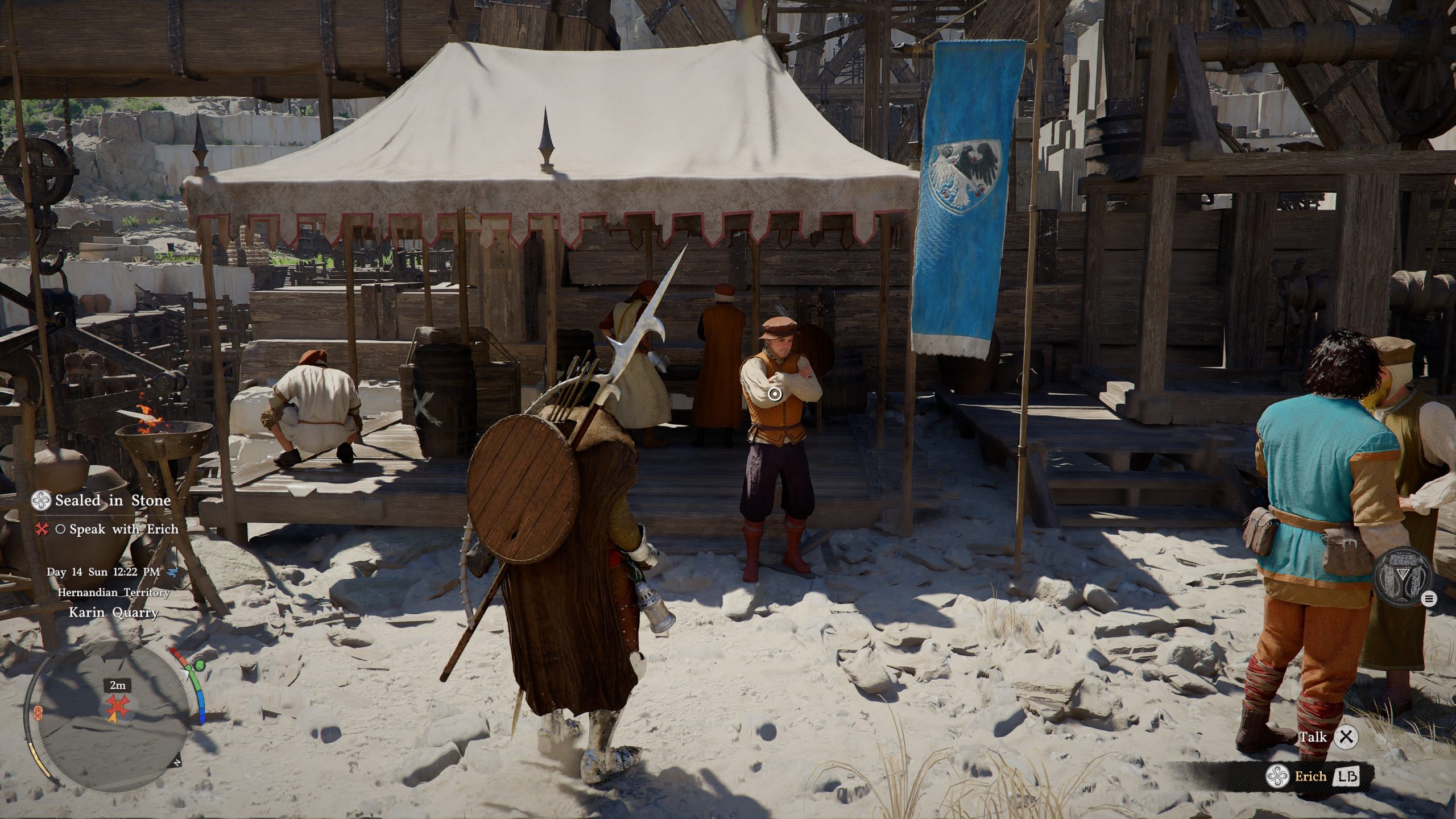
Although Crimson Desert does a lot right, there’s one thing the game is severely lacking in: quality-of-life features.
Let’s start with the controls, which were widely reported to be very complicated before release. Since I did not play other pre-release versions of the game, I do not know how much Pearl Abyss has improved them for the game’s launch, but a level of clunkiness still remains. While I can understand combat controls being more complicated with the huge moveset of each character, traversal controls have no right being so clunky when the game doesn’t do anything hugely different from the competition.
For example, you sort of need to aim to interact with objects if they are grouped close together, which feels really contrived. Even running feels needlessly complicated, as you need to press the run button twice to enter the stamina-consuming dashing state from a basic faster jog. Getting the horse to its max speed is similarly convoluted, requiring constant button presses to keep up speed.
Menus are similarly clunky and needlessly convoluted to use, especially on a controller, requiring too many button presses and combinations to access critical features like the map, the inventory, and the skill trees. Speaking about the inventory, its basic management feels a little dated, and its limited space at the beginning of the adventure is a mild annoyance, as Crimson Desert is filled with items to collect. Expanding inventory space requires a bit of work, such as purchasing expansion items and completing certain quests, mostly item-fetch quests. Sadly, there doesn’t seem to be a storage box, outside of a war chest in the main camp where quest rewards are stored, but it’s a one-way mechanic: once you have taken an item out of it, you cannot put it back.
The general user interface doesn’t fare much better. While the mini-map and the general time-of-day and weather information are quite functional, the interface places the small health bar and the Spirit gauge in an uncomfortable position that forces you to take your eyes off the action to check their status. With so much screen space available, it really doesn’t make sense to cram them into that position.
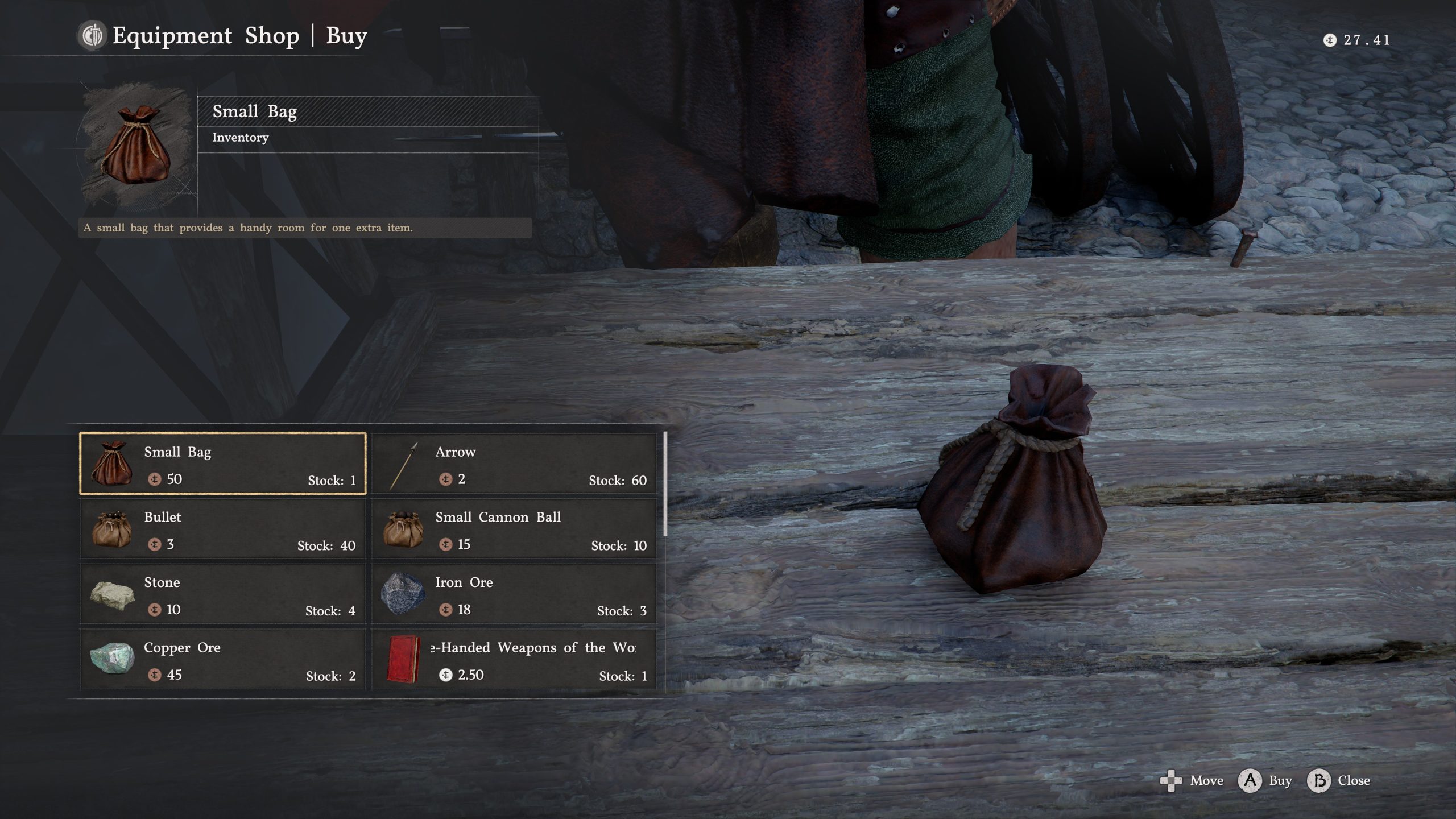
Powering through these inconveniences, I couldn’t help but remember something I noted a few years ago when reviewing MultiVersus. If everyone is doing things a certain way, in terms of controls and interface, it’s because it works best, not just because someone wanted to force a sort of industry standard. Unfortunately, Pearl Abyss took a different approach, and it doesn’t work too well, but these are the sorts of issues that can be easily addressed post-launch or smoothed out. At the very least, I hope the ability to remap controller controls is introduced soon.
All the above isn’t to say that Crimson Desert is completely lacking in quality-of-life features. Once you accept a quest, both the bigger map and the mini-map will show the general area the quest is set in and an icon indicating to which faction the quest belongs, which makes it easy to complete them as you organically travel through the world, rather than having to go with the stiff checklist approach of many open-world games. The ability to change camera settings on the fly is also a nice touch that neatly takes into account situations where vegetation or other environmental elements get in the way.
Graphics and Performance
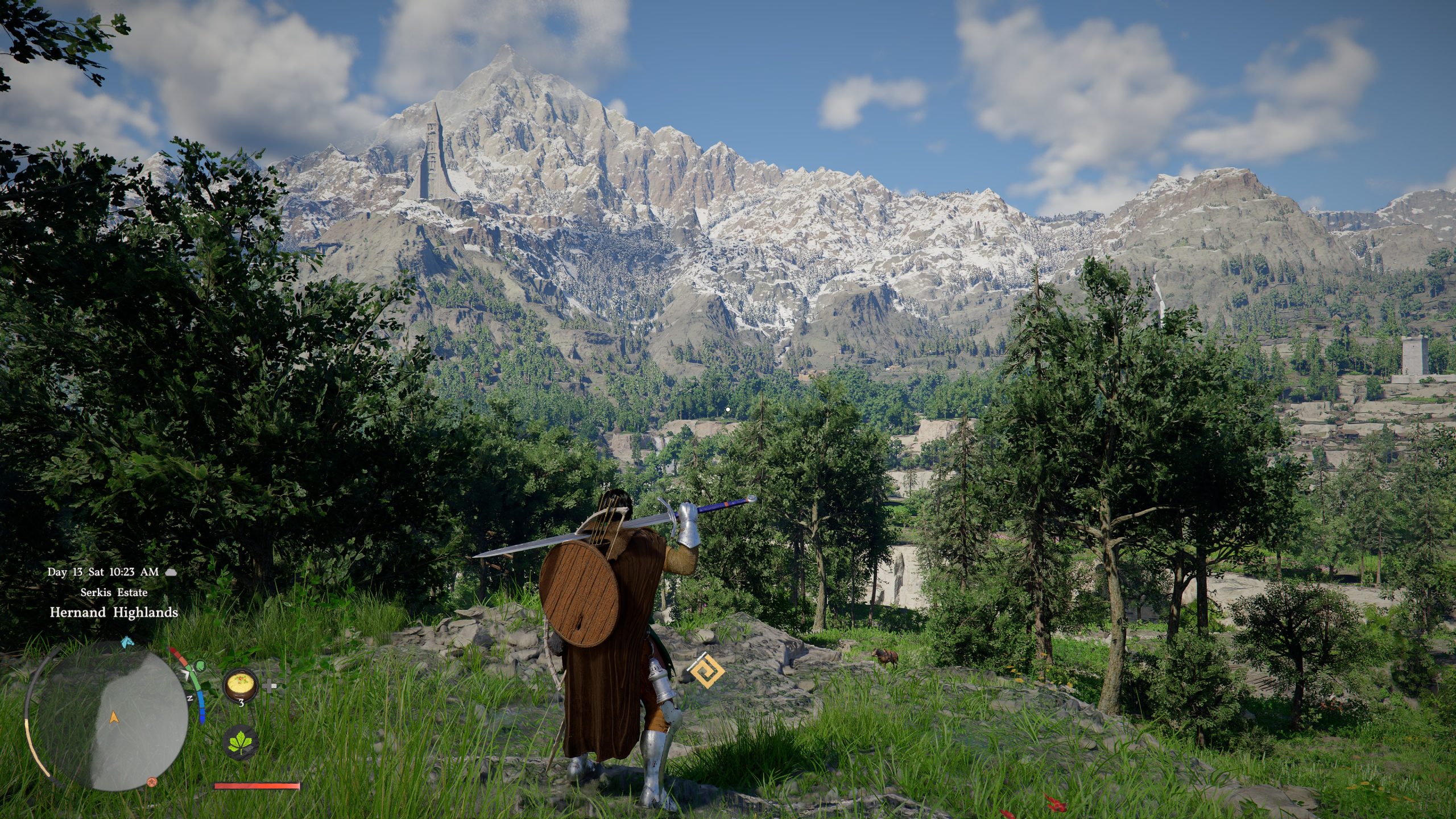
Besides seeing if Crimson Desert would tie all of its wildly diverse mechanics in a cohesive manner, the biggest question about the game was about performance. The game always looked stunning, with ample ray tracing to render time of day and interiors as realistically as possible, but what are the performance costs?
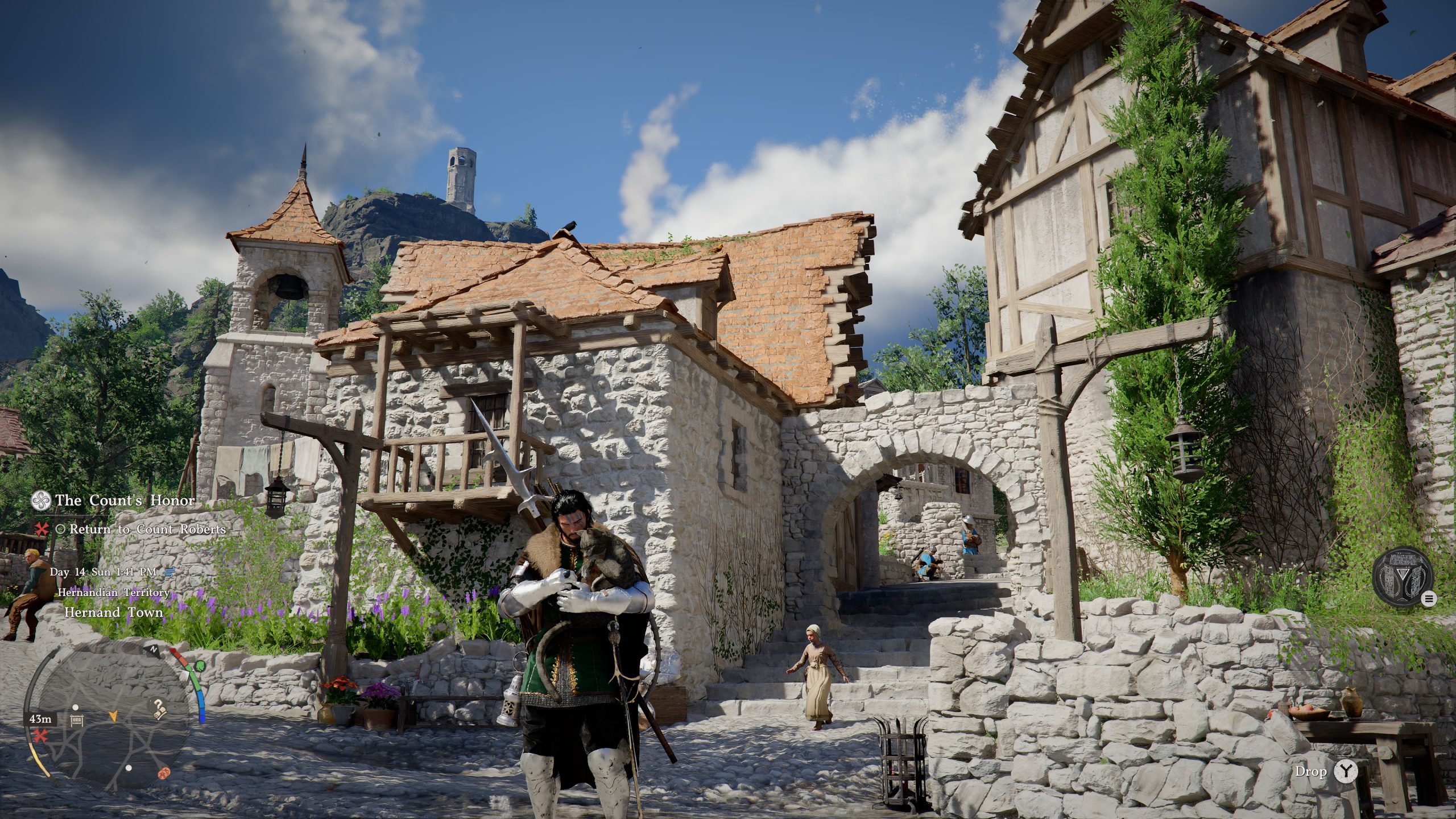
Let’s start with the very basics: the game does indeed look stunning. With incredible scale and draw distance, tons of special effects like volumetrics and particle effects, and great ray tracing, Pywel is one of the best-looking open worlds of all time. Character models are also extremely detailed, and their smooth animations make every moment of the game a joy to experience. Animations, in particular, help combat a lot, as they perfectly convey the impact of weapons and special techniques. There are, however, some pop-in issues and some other visual glitches, but they are, in all honesty, very minor, considering the sheer size of the game. One thing I really appreciated was some very dark nights: if the weather’s bad, the lantern will be your only salvation.
With such advanced visuals, many were expecting performance to be far from perfect. However, that is not the case. The Blackspace Engine has been built specifically to accommodate the game’s visuals and mechanics, and it shows. At native 4K resolution with NVIDIA DLSS in Balanced Mode, and mostly high settings, the game ran at an average of 85 FPS, 67 FPS (1% low) on my system (i7-13700F, RTX 4080, 32 GB RAM) when traversing the Hernand region, getting into as many situations as possible where multiple NPCs act on screen. With Frame Generation, my system often hit the 120 FPS cap of my monitor, and with limited input delay thanks to the high base framerate.
Unfortunately, the one feature that makes a noticeable difference in terms of ray tracing quality on an NVIDIA RTX GPU, Ray Reconstruction, is really taxing and has a massive performance impact. In the same testing scenario above, the game ran with it at an average of 37 FPS, 33 FPS 1% low, making it not really viable without using more aggressive upscaling. Frame Generation can also come to the rescue here, but the input delay with a base framerate so close to 30 FPS is really bad, so I ended up continuing my adventure in Pywell without Ray Reconstruction.
The best thing about Crimson Desert, in terms of performance, is that it does not suffer from any major stuttering issues. Though there are times when things do feel a little “choppy”, it’s only for a few moments, and they are not really comparable to some of the performance disasters seen in Unreal Engine 5 games. As I did not have the chance to test out the console versions of the game, I do not know if the experience is just as smooth on PS5 and Xbox consoles, but for the PC version, the system specifications and the expected performance are a real indication of what can be achieved on different system configurations, so I expect the game to run as Pearl Abyss announced before release.
Closing Thoughts
Although I am not ready to emit my final judgment on Crimson Desert, I already have a pretty definite opinion of the game. If I were to score it based on my current experience, the game is in the 9.0 out of 10 range. It is very fun and gripping, and a game that is very easy to get lost into with an incredible world density. Although filled to the brim with lots of fun activities, the lack of cohesion between all of the game’s elements and the serviceable and far from stellar narrative and paper-thin characters have an impact on the experience, as does the lack of certain quality-of-life features, and will likely prevent it from being the game of the decade some were hyped for.
However, the more I got accustomed to the game’s quirks, the more I started to believe that Crimson Desert has the chance of being this year’s Baldur’s Gate 3. It does nothing truly revolutionary, but what it does in terms of mechanics is done so well that I expect it to become a sort of benchmark moving forward for all open-world games.

PC version tested. Review code provided by the publisher.
You can find additional information about our standard review process and ethics policy here.
VIA: wccftech.com

