

It’s been more than seven years since Denis Dyack, the creator of classic action/adventure games Eternal Darkness and Blood Omen: Legacy of Kain, originally announced Deadhaus Sonata. First described as “Bloodborne meets Diablo”, it was supposed to include Genvid‘s interactive streaming technology in a persistent world where, according to my previous interview with Dyack from May 2020, players might have been able to change the government through elections or simply act as a store manager or dungeon master.
For a long while, though, the game largely disappeared from the news, only to reappear recently with a playable demo on Steam and the promise of a debut later this year on Steam Early Access. I thought it was high time to get up to speed with Dyack and see how he and his independent company, Apocalypse Studios, have been shaping Deadhaus Sonata over the last few years. While the interactive streaming stuff is gone due to Genvid’s closure, the latest iteration of the game does include a couple of interesting features, one of which is highly innovative, to say the least.
In the chat, which you can find fully transcribed below, Dyack discusses the funding issues caused by certain industry events, his take on AI’s impact, his experience working with the recently retired Phil Spencer, and, yes, also his undying love for Eternal Darkness.
In this Deadhaus Sonata interview:
Various Tech Changes
The last time we spoke, you were still using Genvid’s interactive streaming technology and also mentioned using the cloud. That seems to be gone now from the game’s design, right?
Denis Dyack: Well, yeah. Certainly, Genvid’s no longer around, so that technology is not available. It was really cool for sure. But yeah, that’s gone by the wayside. As far as using the cloud goes, we are still using AWS because Deadhaus Sonata is persistent. But as far as using the cloud for studio machines, we’ve gone back and forth and sort of use hybrids now. Our studio has been remote since the pandemic. I can’t remember if the last time we talked was pre or during the pandemic, but since the pandemic, we’ve stayed remote as a company. I never thought that would be possible, but once we all went remote and the team was senior enough (we’re super small), everyone liked working remote, so we don’t have an office.
There were quite a lot of changes to Deadhaus Sonata between Genvid’s technology no longer being available and the pandemic. And then you also changed the engine a few times, I think?
Denis Dyack: Several times. Yeah, we’ve gone through almost every engine that’s been available, from Crytek all the way to Lumberyard to O3DE to Unity, and now we’re on Unreal Engine 5. So we’ve run the complete gamut, I would say. It is a learning experience, and one that has taken us time to get here, but we’re very happy with Unreal right now. It’s really doing great stuff for us. We’re excited about it.
Are you on the latest 5.6 or 5.7?
Denis Dyack: We’re on 5.5. We tend to stay generally about one version away from the most recent version just to stay safe with bugs and stuff. My guess is we’ll be upgrading soon because Epic usually releases a new version around GDC, which is right around the corner. We’re looking forward to that, and there are some features in the latest version that we do want to start using.
5.6 has some performance enhancement features as well, so I think you’ll be excited about that.
Denis Dyack: Absolutely. Performance is a very difficult thing. We’re starting to look at it now as we’ve released a demo on Steam. We’re working with a lot of people, even over Twitter, to ask, “What’s your frame rate with these changes?” We’ve gotten some encouraging performance changes, but we’ve got a long, long way to go.
Industry-Wide Upheavals
In a recent interview, you spoke about what happened with Embracer disrupting the industry for smaller developers. How did that impact your development of Deadhaus Sonata? Because in 2020, you were targeting 2021 or 2022. I guess that was a major factor in your delay.
Denis Dyack: Yeah. I can’t say with whom, but we were told pretty much we had a deal done, and it got pushed back and pushed back and then eventually canceled. But we weren’t alone in that. There were hundreds and hundreds of developers who faced that same thing. I talked to several people who got exactly the same messages. So we went from thinking we had a deal closed and were on the way to going into full production with a much larger team, to the point where we just watched many of our friends go out of business, waiting for that call to come in and realizing it was never going to come. It’s very tough to see that.
I think more than anything, it really emphasizes that the industry needs to change from the standpoint of the way games are funded to the way they’re developed. I often see on Twitter or YouTube comments that people are not very excited about big-budget titles, and that there’s something structurally wrong with the way games are approved. Games are being approved and directed in such a way that gamers definitely don’t want right now. If anything, gamers are getting really frustrated not only by games going in a direction they don’t want, but also by having to pay higher prices for them. It’s almost like gamers are revolting against these kinds of things.
It makes me sad because the AAA industry and bigger budget titles take years and years to create. Because of that, this sort of extinction-level event that happened a few years ago is likely to go on for two or three more years. The games that are currently in production going in the wrong direction will be able to make minor corrections, but they’re not going to be able to make major corrections. So I think gamer anxiety and disappointment are going to continue, and there’s not really much people can do about it because these games take so long. From that standpoint, I guess the silver lining is being smaller and hopefully very original, so we can adapt. We’re getting feedback now from gamers. I think that’s why the indie scene is becoming so vibrant right now, because it can adapt very quickly to what gamers are requesting. It’s going to be interesting, that’s for sure.
Yeah. It’s a time of upheaval in the gaming industry.
Denis Dyack: Massive upheaval. And I think we’re going to see a lot of big failures still. Time will tell, I guess.
Deadhaus Sonata’s Demo Feedback and Early Access Plans
So you decided to bring Deadhaus Sonata to Early Access, right? Why did you decide to go with that release model?
Denis Dyack: Well, with Early Access, we will get more direct feedback from gamers. It will give us a chance to iterate with people who are playing our game and start a flywheel where we iterate to the point where we’re in sync with gamers. The concept itself for Deadhaus Sonata is huge. It’s got a lot of very interesting, unique, and novel ideas, like the tarot card loot system or a deterministic RPG system based on quantum theory. There are some things that are way out there, and we’re getting a lot of feedback already just from the demo of people not understanding what’s going on. We’re adapting to that very quickly. By going into Early Access, the hope is that people understand the game’s not finished, but we can adapt to what gamers want to see and hopefully create an alignment where we’re going in a direction that gamers will support.
You mentioned the demo. How is that going for you? What kind of feedback did you find most often from the community so far?
Denis Dyack: Really good feedback. A lot of people really like the concepts and the direction. Of course, we’re getting feedback that it’s early and needs more work. We know that. We’re taking as much feedback in as we can. We’re updating the build almost every day since Steam Next Fest. Once Next Fest is over, we’re going to take it back in and launch another demo with more features and fixes, addressing some of the missteps we made in the first demo. For example, we thought the tarot card skill system was pretty straightforward, but a lot of people are not understanding it. And certainly, the celestial clock, where we get into the deterministic system, is something a lot of people do not understand. So we’re going to figure out how to explain this better when you start the demo. We’ll take all that feedback, roll out another demo, and just keep iterating.
Tarot Cards, Quantum Physics Loot, Legacy of Kain Inspiration
Let’s talk a bit about these more innovative systems. How does the tarot card system work?
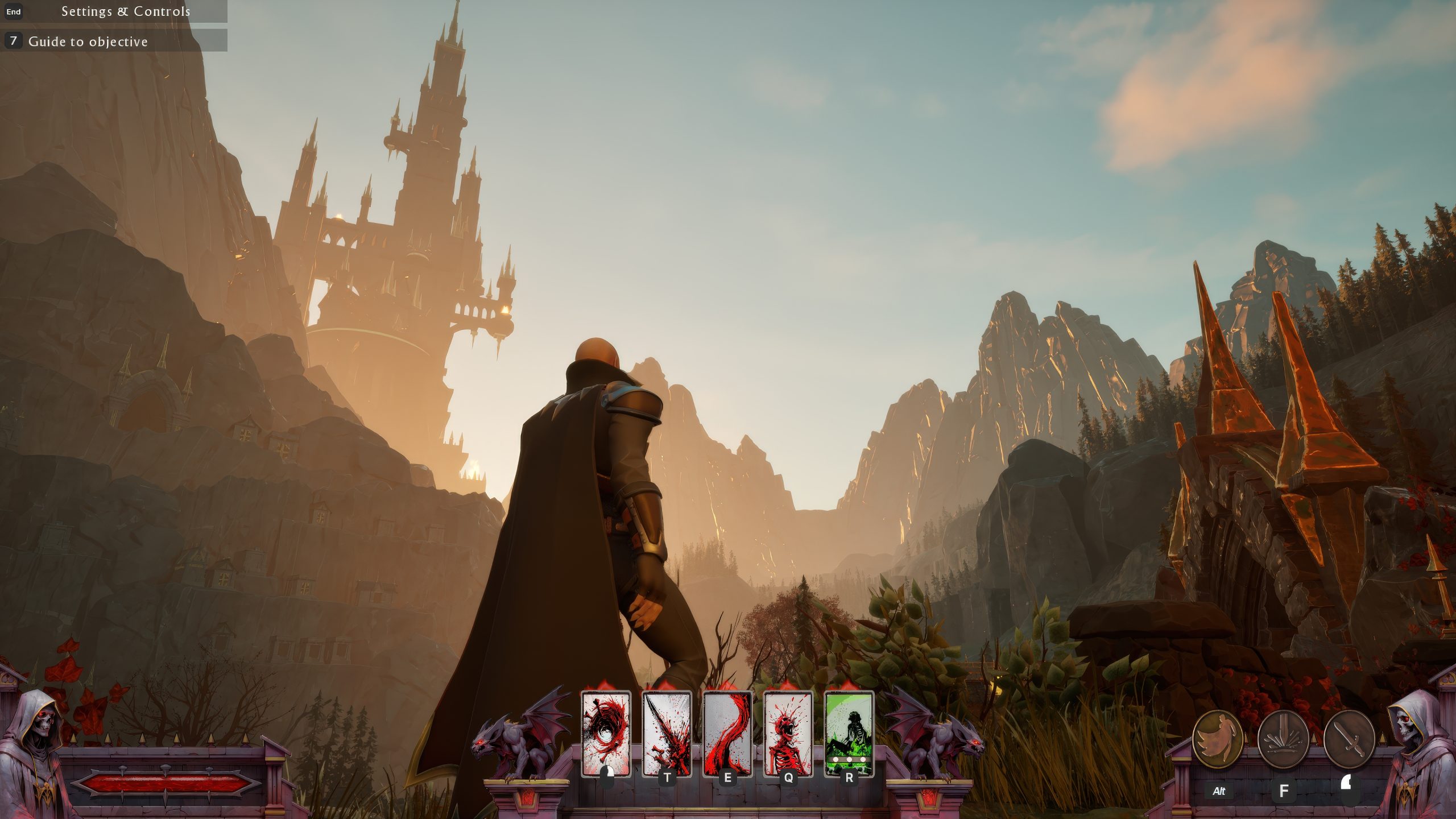
Denis Dyack: For sure. Being a huge action RPG fan, I love the whole idea of looking at skills and creating synergies, like a spin-to-win with some kind of poison effect on it. That’s the most fun part of an action RPG. But once you get to max level, what inevitably happens with any class is you have to just go to the meta and see what the most efficient build is. To me, that’s kind of boring, and you lose that sense of discovery. With the tarot card skill system, you have a tarot card that represents a skill that you can swap out at any time. Right now, we’re starting with the Vampire class. Imagine having 50 tarot cards and you can only take five on a mission. It’s essentially like a card game where you can upgrade these skills, but you can swap them out, giving you a constant sense of discovery. You can get rare cards that really enhance your playstyle.
And the deterministic RPG system?
Denis Dyack: That’s something very new, and I haven’t seen it anywhere before. I would describe it as an answer to RNG systems. In a game like Diablo or Path of Exile, you’re dispatching enemies and hoping for that 1% loot drop to get a rare item. If you don’t get it, you grind until you do. That mechanic has been around for 35 years. We’re not saying there’s anything wrong with that, but we wanted to try something different.
I spoke with some of the top quantum physicists in the world, and one of them said that our understanding of the universe as 3D objects moving through time and space was thrown out and replaced by “we are our history.” This meeting we’re having right now, all the past interviews you’ve done, all the games I’ve made… All of our histories come together to describe our universe. So we thought, what if we created an RPG system that wasn’t random? What if we took all the things you did in the game, your history, your performance, the state of the universe, planet alignments, moon phases, weather… and combined them to deterministically give you your weapon?
We like to say “playing is crafting and history is currency.” What you do determines your loot, not a random number. The system is super early, but we’re getting feedback from our NDA community testers that it’s really fun to reverse-engineer and try to figure out what’s getting you the bonus stats. They become almost like mini-quests.
Is this based on combat choices, progression choices, or even dialogue choices?
Denis Dyack: There’s no limit. It could be based on any choice. Rather than even taking a single point in time, you can take the player’s history over a period of time as a deterministic factor. Braiding these deterministic factors is one of the most interesting engineering tools I’ve seen in a long time.
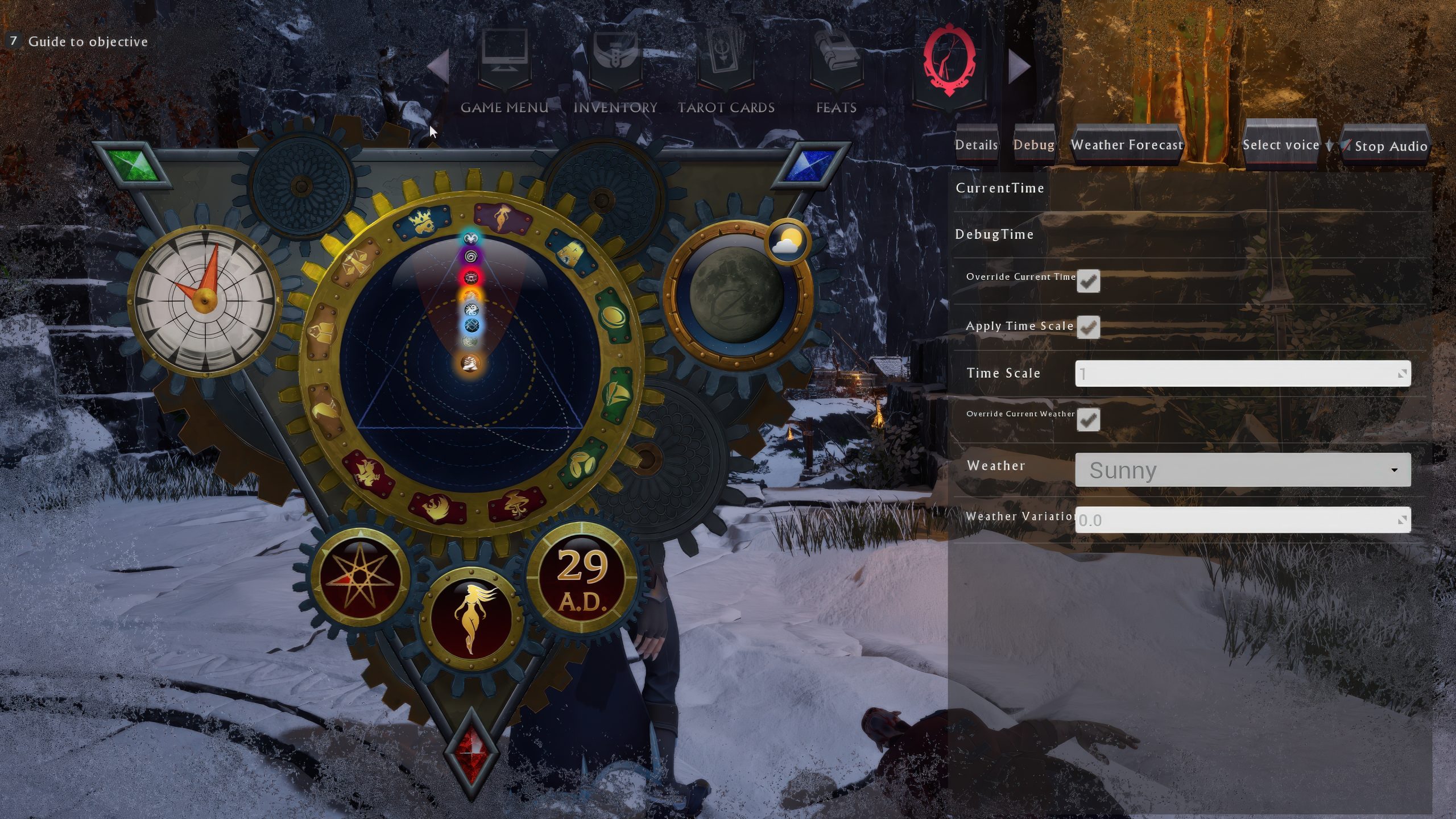
You mentioned the celestial clock playing a part in it. What is that exactly? Is that a planet alignment system?
Denis Dyack: Deadhaus Sonata is a spiritual successor to Blood Omen: Legacy of Kain. In Legacy of Kain, we had moon gates that only opened during a full moon. In Deadhaus, we have this times a thousand. The celestial calendar simulates the entire solar system: time of day, weather, seasons, even moon phases. We model the weather in great detail. We essentially have a simulation running in the background that directly affects the game. For example, in a thunderstorm, archers are not going to fire as accurately or as quickly. In a snowstorm in the middle of winter, humans are not going to move as fast or be as agile as they would in the summer.
Right now, one day in real life is approximately a month in the game. People would play the demo, come back four or five days later, and what was summer last time is now winter with snowstorms. It totally changed their interpretation of the game.
In your latest Steam update, you mentioned how narrative affects the game, with the world responding to your decisions and persistent changes others can see. Can you get other endings eventually?
Denis Dyack: It’s going to be a lot more fluid than that. We will allow people to change the world just by playing the game. Imagine you do something very special and it gives you an opportunity to spawn a dark tower. Let’s call it Alessio’s Dark Tower of Doom. You found that tower, and suddenly it’s in the level. Well, other players are going to see that as well. So rather than typical narrative branches, we’re doing a community approach to narrative. We plan to give players tools to create their own areas and mini-quests so they can craft the world as well as we do. Everything you do counts and influences your character, your story, and your choices.
When it comes to community stories, is that the connection to World Anvil?
Denis Dyack: Yes, World Anvil is one of the groups we’ve teamed up with. People are submitting radio plays and stories through World Anvil already. We’ve also teamed up with groups where people will be able to create maps and layouts to import into the game as well. We want to let players be creative.
In the previous iteration of the game, there was also PvP, which seems to have been removed. Are there plans to eventually reintroduce it?
Denis Dyack: I don’t think we’ve removed any plans for PvP, per se. The game starts with Deadhaus, where there’s going to be seven classes, and it’s cooperative. But as the game scales, there are eight other houses, like the House of Giants, the House of Angels, the House of the Mind. One of my favorite games of all time is Heroes of Might and Magic 3, and as we start introducing new houses and classes, some of them will be cooperative, but some will be competitive. Most people are going to want to play cooperatively, but we will probably put in competitive elements for taking over territories, and maybe direct PvP. Introducing PvP is something you should only do after the game really has a solid foundation of gameplay.
You mentioned seven classes. Beyond the Vampire, what are the other ones?
Denis Dyack: We’ve got the Revenant (a very tanky, heavy melee class), the Lich (a caster), the Banshee (her voice is the voice of gods), the Wraith (crowd control, torture elements), the Wight (construct your own), and the Ghoul (the theme is “you are what you eat”). We’ve got a lot of very distinct classes, and with the tarot card system and how people mix and match cooperatively, it’s going to be very interesting.
Are the tarot cards unique to classes, or are they shared?
Denis Dyack: There may be some shared cards, but overall they will be generally unique for each class.
You’re planning about 18 months of Early Access on Steam, correct?
Denis Dyack: Yep. That’s what’s planned.
Afterward, will you also launch the game on consoles?
Denis Dyack: 100%. Yes, that’s been the goal from day one. We’ll lead on PC, then go to the consoles when we feel the game is ready. By the time we do go to consoles, it’s probably going to be timed around the new console launches, which I think have maybe been delayed by a year or so because of hardware issues worldwide.
Does that include the Switch 2? Do you plan to launch there?
Denis Dyack: 100%. I’m a huge Nintendo fan, of course, and have a lot of friends at Nintendo. We will always support Nintendo.
I also have a few industry questions. There was a major shakeup at Microsoft, with Phil Spencer retiring. I don’t know if you ever got to work with him…
Denis Dyack: I knew Phil very well. He oversaw and completed Too Human, actually. We talked a lot about it. He’s a very good guy.
What do you feel his legacy is now that he’s left?
Denis Dyack: He did a great job. He really grew Xbox. He took Microsoft’s game division from a medium-sized player to one of the biggest in the world. He was a gamer at heart. The market is getting very, very tough now, and they’re going to face a lot of headwinds, so the new person coming in is going to have it tough. But he positioned Microsoft on very solid ground to succeed.
The Impact of AI on the Industry
They picked a person who was previously in charge of Core AI at Microsoft. That led to a lot of criticism and fear that AI is going to take over at Xbox. Even Seamus Blackley, the original founder of Xbox, claimed she’s just going to shut down the division eventually. What do you think?
Denis Dyack: That’s extreme. I don’t have any inside knowledge, but I think it was a trendy decision. AI within corporations is trending really high right now. Whenever you mention AI, which is where almost all investment funding in tech is going right now, investors like it. So I think from a business perspective, that’s probably why that choice was made.
I do think AI is a pretty big bubble right now and there’s a lot of unjustified fear that AI is going to take over or remove creativity. My background is in AI; I put a running neural network in a game back in 1992 for my master’s thesis in Computer Science. AI is a tool. It’s not a replacement for people. Corporations saying “we’re laying off X amount of people because of AI” are really going to regret that decision. You cannot finish a game with AI, or if you do, it’s awful. Putting someone who comes from AI to run a games division isn’t a first; people who run game divisions have often never done games before. But if there’s going to be a large application of AI within games, I don’t think it’s going to be that fruitful.
AI is way overhyped right now. Its ability to get results on its own is very low. As soon as someone says AI is going to save you money, you can almost universally assume that’s wrong. Technology makes you more productive, but it takes more time. If you use a lot of AI, you need a lot more people and a lot more time. The idea of laying people off because of AI is antithetical to reality.
Peter Moore recently said in an interview that he thinks all studios will eventually use AI in some form or capacity. Do you agree with that?
Denis Dyack: All studios are already using AI. It’s impossible not to. Steam’s AI disclaimer is performative theater. It’s in our compilers, our editors, our engines. If you use DaVinci Resolve for cutting videos, it’s full of AI. That ship sailed about 15 years ago. The real question is: is generative AI going to replace people? I don’t agree with that. It’s probably going to take more people to run.
There are mods for PC games like Skyrim or Bannerlord that connect NPCs to LLMs, letting you get dynamic answers in-character. Do you think that could be useful to RPGs?
Denis Dyack: For sure, to an extent. I think that could be very cool, especially with a dynamic and evolving world. But right now, AI is being focused on doing things that humans already do well. I think the real win in AI is going to be focusing on things that humans can’t do, like going through large amounts of data very quickly. Will you get written dialogue that’s as good as a writer? No. Are you going to get voice acting that’s as good as a voice actor? No. Our extensive tests show that voice actors are significantly better than AI generated from text. I think we want to focus on things AI is uniquely suited for rather than trying to replicate human work.
How do you feel about NVIDIA’s recent reveal of DLSS 5?
Denis Dyack: The recent reveal of NVIDIA DLSS 5 was a mistake and needs to go back to the drawing board. The current release seems to go beyond enhancing the look of a video game by fundamentally changing the game’s art direction. Never mind the artifacting and other AI art issues. The AAA industry is already in trouble, as it has become very difficult to justify production costs. Making things look spectacular is AAA games’ greatest advantage over smaller budget games. If DLSS 5 is widely adopted, it will accelerate the AAA process’s extinction, as it takes away the awe of what high-production art can bring to the table.
Eternal Darkness Successor?
One of my favorite games is Eternal Darkness. A few years back, you were trying to kickstart a spiritual successor called Shadow of the Eternals. Is that still the goal after Deadhaus Sonata?
Denis Dyack: If Deadhaus Sonata succeeds, absolutely. There’s all kinds of potential there, including potential to work with Nintendo again. I love making games, and if you’re asking if I would like to do a follow-up to Eternal Darkness, 100%. It has a special place in my heart. One of the reasons we started Apocalypse Studios was to bring back the voice that was lost with games like Legacy of Kain and Eternal Darkness because no one’s making them anymore. There’s a want by gamers for thoughtful narrative, and I’m very bullish on gamers resonating with what we’re creating.
Yeah. Novels, TV, and films have the same function to escape, but games are the only interactive medium.
Denis Dyack: It’s the best medium in my opinion. And that’s why I’m sticking to it.

Agreed. Thank you a lot for your time.
Follow Wccftech on Google to get more of our news coverage in your feeds.
VIA: wccftech.com

