

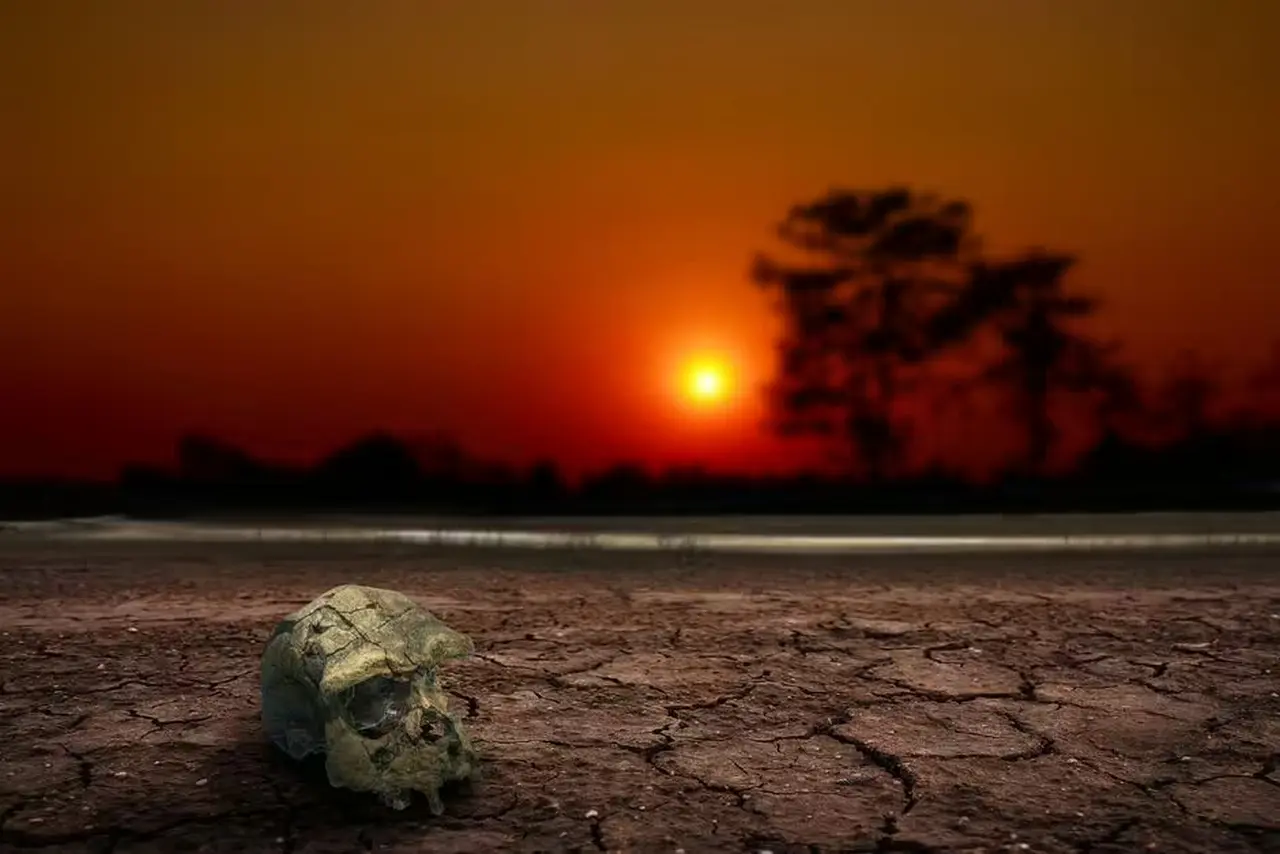
Humanity seems to be facing an absolute responsibility for its survival as the “Doomsday Clock” approaches midnight. With contemporary geopolitical crises, such as the war in Μέση Ανατολή, the challenges facing humanity are immense. From dangerous climate change to the destructive effects of artificial intelligence, the situation seems bleak. However, beyond the man-made dangers, Earth has a natural expiration date approaching, raising concerns about the future of our planet.
According to a study by scientists Kazumi Ozaki and Christopher T. Reinhard, that end may be closer than we thought. Their data suggests that life on Earth could become impossible much sooner than previously estimated.
About 2.5 billion years ago, conditions in Earth's atmosphere were very different. With little oxygen in the atmosphere, microbial life emerged, consuming carbon dioxide and producing oxygen, one step ahead of the Great Oxidation Event. This mass extinction nearly wiped out life on the planet, leading to the creation of an oxygen-rich biosphere that supports life today. This process was accompanied by major geochemical changes that transformed Earth forever.
However, Ozaki and Reinhard emphasize that the oxygen-rich atmosphere that constitutes today's ecosystem is a temporary phenomenon. Using data from NASA's Astrobiology Institute, they determined that the end date of the atmosphere as we know it is closer than we thought. "For many decades, the scientists "They are investigating the lifespan of the biosphere based on the steady increase in the Sun's brightness," Ozaki points out.
While it was traditionally believed that changes in the Sun's brightness would render Earth uninhabitable in about 2 billion years, new research suggests the end could come in as little as 1 billion years. This was revealed by computer models developed at NASA, with the estimate of the extinction of life placed at around 1.000.002.021.
While some may feel panicked, the truth is that there is hope. The future of humanity depends on how successfully we confront our self-destructive tendencies. trends and if countries work together to address climate change, which threatens to come sooner than that deadline. We hope that science should provide solutions, and perhaps we'll see human missions to other planets when the time comes.
The scientists added that Earth's photosynthetic biosphere continues to deliver large amounts of oxygen to the ocean-atmosphere system, with the current atmosphere consisting of about 20% O2 by volume. However, the ability of plants and microorganisms to have the "last word" is questionable, as the atmosphere may not be sufficiently oxygenated for the next millennia.
Meanwhile, the estimated expansion of the Sun towards the end of its life will transform the Earth into a heat wave, wiping out water and destroying conditions favorable for life. Our planet's evolutionary path will be similar to that of other planets in the Universe, as NASA plans projects such as LUVOIR (Large Ultraviolet Optical Infrared Surveyor), which will be able to observe these changes.
The study was published in Nature Geoscience, emphasizing the need for international cooperation and scientific innovations, as well as a better understanding of the Darwinian process of our planet.