


Agentic AI: Η Artificial Intelligence που Ενεργεί Μόνη της — Και Αλλάζει Τα Πάντα το 2026
If you think that ChatGPT ήταν η μεγάλη αλλαγή, τότε η Agentic AI is the next level — and we haven't even seen 10% of what's coming yet. Artificial intelligence stops answering questions and starts does chores on its own, making decisions, collaborating with other AI systems — and in some companies, already serving as a virtual employee.
What Is Agentic AI — And Why It's Not Just a Chatbot
A traditional AI tool like ChatGPT works like a smart “questionnaire”: you give it a command, it gives you an answer, and that’s it. A AI Agent It works completely differently: it takes on a goal, divides it into steps, executes each step autonomously, manages tools (email, APIs, databases, browsers) and delivers results — without the need for constant human supervision.
The difference is substantial. You can tell an Agentic AI: “Do market research on our top 5 competitors, write a report and email it to the marketing manager” — and this he will do, without any further command from you.
The Difference in a Table
| Traditional AI (ChatGPT) | Agentic AI |
|---|---|
| Answers questions | Performs multi-step tasks autonomously |
| Waiting for a command for each step | He decides the steps on his own. |
| Works individually | Collaborates with other AI agents |
| Does not "remember" ongoing processes | Manages long-term workflows |
| It requires human supervision at every step. | Operates with little or no supervision |
The Numbers That Make Managers Lose Sleep

Gartner explicitly states this in the report “Top 10 Strategic Technology Trends for 2026”: Agentic AI is at the top of the list. And the numbers are impressive:
- 66% of organizations already using AI agents report significantly higher productivity.
- 57% report a measurable reduction in operating costs.
- As of 2030, 80% of companies will have smaller teams of software engineers — augmented by AI tools.
- Until 40% of job roles at the world's largest companies will interact with AI agents daily by the end of 2026.
- Deloitte analysts estimate that AI chips will only reach 500 billion dollars in revenue by 2026 — about half of the global semiconductor market.
The semiconductor market in 2025 was $792 billion, with growth of 25,6% compared to 2024 — the strongest pace since 2021. And 2026 is expected to be even better, with estimates for growth of over 20%.
How It Works in Practice: 3 Real-Life Examples
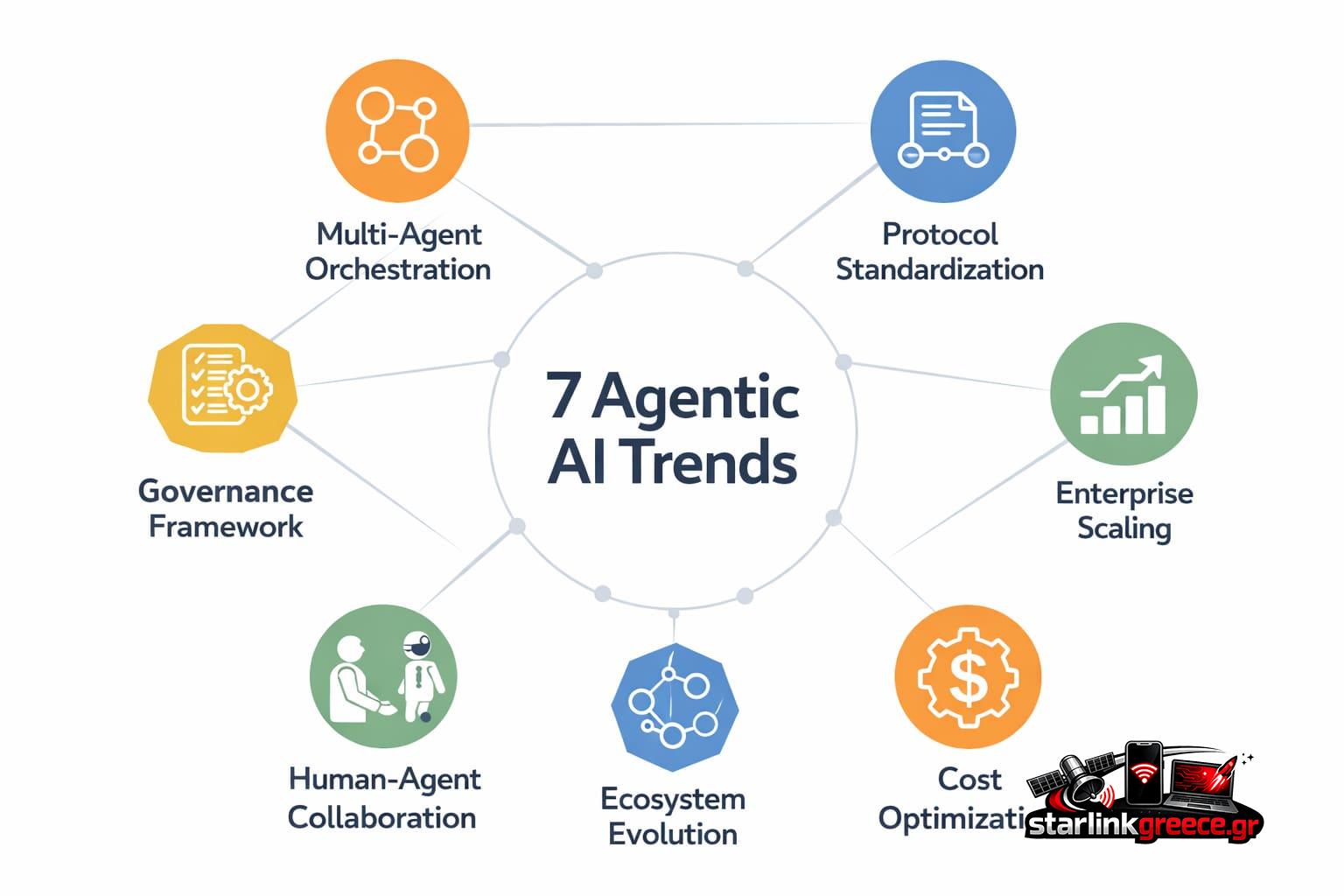
Agentic AI is no longer a theory. Companies around the world have already put it into production:
1. Compliance Automation in Banks
Η e& (Etisalat) in collaboration with IBM announced at the World Economic Forum in Davos (January 2026) the development of enterprise-grade Agentic AI for governance and compliance. AI agents autonomously undertake regulatory audits, identify violations and write reports — tasks that used to be done by teams of dozens of lawyers.
2. Multi-Agent Teams in Enterprises
Imagine a procurement workflow where: one agent searches for suppliers, a second negotiates prices, a third checks legal compliance, and a fourth approves the budget. This is the “Agentic Mesh” — networks of specialized AI agents that collaborate like a team of people, without having to say anything to each other.
3. Generative Coding: Developers with AI Copilot
MIT Technology Review included the Generative Coding in 2026's 10 breakthrough technologies: AI tools that write, review, and deploy code autonomously. GitHub Copilot, Cursor, and dozens of competitors have already changed the way developers work — and in 2026, it's accelerating.
The Dark Window: Risks No One Mentions in Marketing
- Unclear ROI: Many companies deploy agents without having measured what they want to achieve.
- Governance gaps: If an AI agent makes the wrong decision autonomously — who is responsible?
- Cyber Security: Agents that have access to email, APIs, and databases are becoming new attack surfaces for hackers.
- Runtime cost: LLM models are expensive when running continuous tasks. Without control, costs skyrocket.
Cybersecurity in the new AI environment is becoming increasingly complex — something that also touches everyday technology users. If you're interested, see how Google strengthens Gemini AI against malicious ads — a prime example of how AI itself becomes a defense tool.
What Does This Mean for the Average User in Greece?
The Agentic AI revolution is not just about the C-suites of the Fortune 500. It will soon affect every employee, every freelancer, every small business in Greece:
- Freelancers they will be able to "hire" AI agents for research, email management, social media scheduling and invoicing.
- IT departments Small companies will be able to automate monitoring, patching and incident response — ideal for a one-person team.
- E-commerce Stores will use agents for automatic stock management, pricing and customer service.
- Creative professionals (copywriters, designers, marketers) will have AI agents as "assistants" who take on repetitive tasks.
Technological infrastructure plays a crucial role in this transition. The faster and more reliable your internet connection is, the more effectively AI agents based on it will operate. cloudSee the comparison of internet providers in our article about PPC Fiber 2026: Prices, Areas & Provider Comparison.
MIT's 10 Breakthrough Technologies of 2026: The Big Picture
Agentic AI is at the cutting edge, but MIT Technology Review has seen further ahead. In addition to Generative Coding, the 2026 list includes:
- Hyperscale AI Data Centers: Huge facilities that function like supercomputers — the "brains" behind every AI service.
- Sodium-Ion Batteries: Alternative to lithium for electric vehicles — cheaper and with a more balanced supply chain.
- Next generation nuclear power: Small reactors (SMRs) that can power entire cities with zero emissions.
- Autonomous Vehicles: Robotaxis are moving from pilot to everyday urban life in selected cities.
- AI for Scientific Research: For the first time, discoveries in biology and chemistry are being attributed primarily to AI models.
For those who follow developments in space and technology with interest, artificial intelligence is already playing a role in missions such as the NASA's Artemis II — from crew training to trajectory planning.